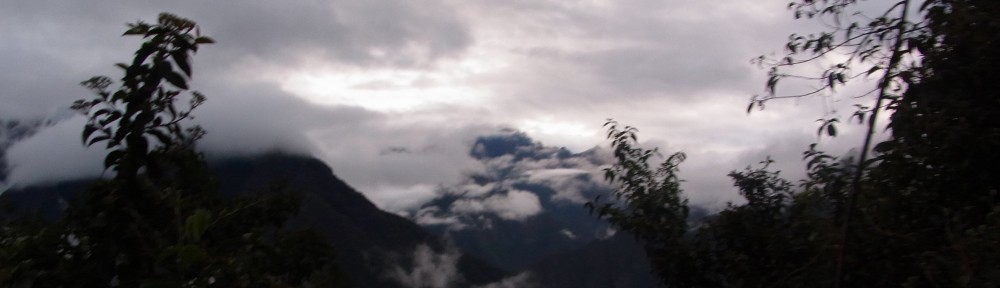
uncommon times series no. 2 — ellery creek by early morn

Image

A photograph of Ellery Creek Big Hole in the West MacDonnell Ranges, Australia. The image shows a calm body of water reflecting the sky, framed by two high, rocky gorges on either side. Sparse, gum-like trees grow along the water's edge and up the rocky slopes. The sky is a bright blue with some scattered white clouds. The overall mood is peaceful and serene, capturing the stillness of the early morning.

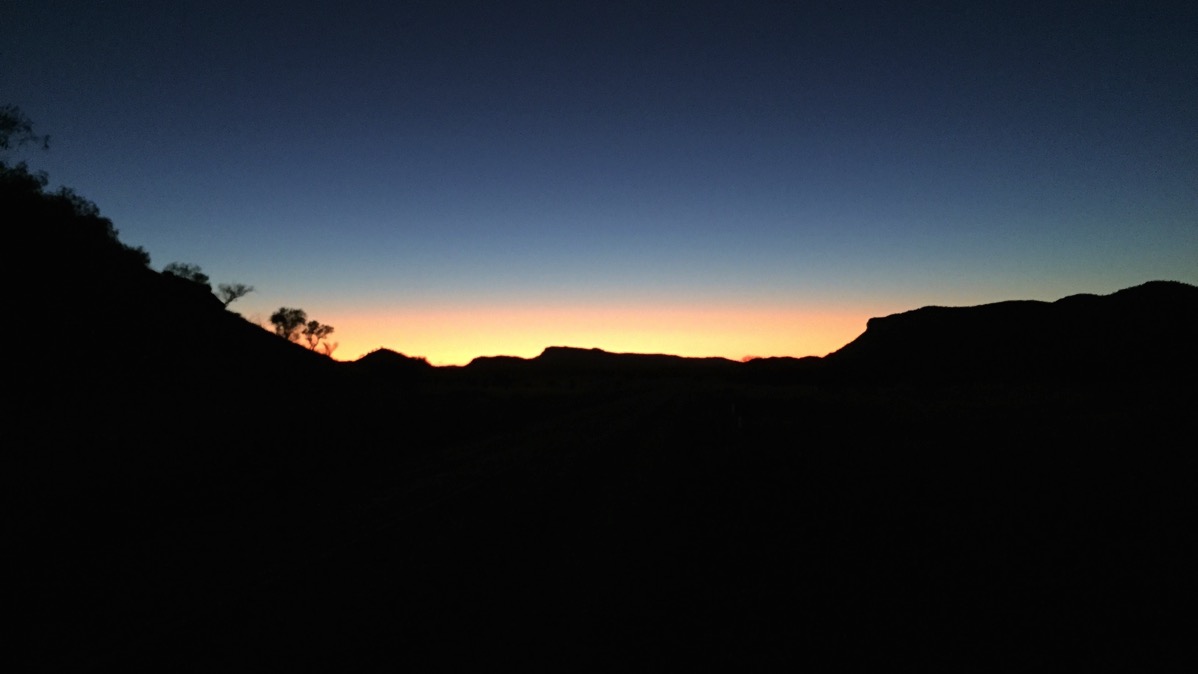
uncommon times series no. 1 — west mcdonnell range before real light

Image

A photograph capturing the pre-dawn glow over the West MacDonnell Ranges in Australia. The lower half of the image is dominated by the deep silhouette of the mountains and foreground, while the upper half shows a gradient sky transitioning from deep indigo at the top to a vibrant, fiery orange and yellow at the horizon line.

sand-stone misnomer

the heavitree range, it would appear 
is not
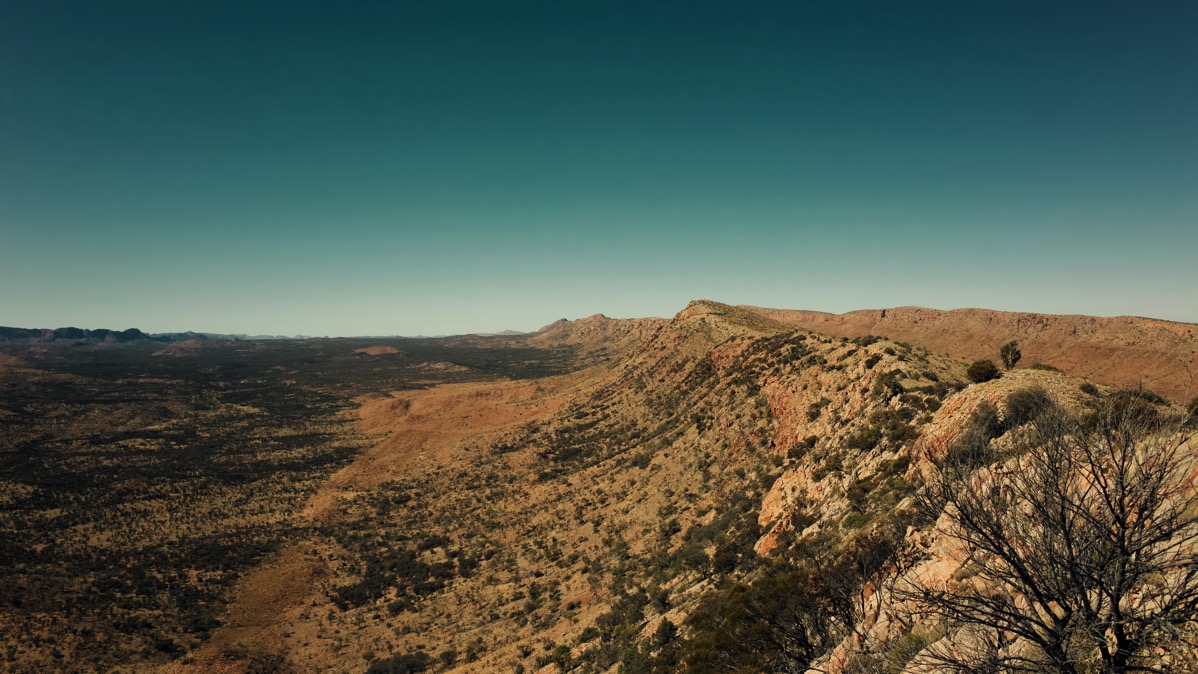
A wide, panoramic photograph of the Heavitree Range, an arid and rugged landscape under a clear, light blue sky. Despite the name suggesting trees ("Heavy-tree"), the scene is characterized by undulating, rocky terrain with sparse, dry vegetation and no prominent trees visible across the vast expanse. A distant ridge of low mountains forms the horizon. The color palette is dominated by earthy browns, yellows, and grays, emphasizing the stark and open nature of this Australian environment.

as craggy habitat, it's no match 
for sandy river gorge
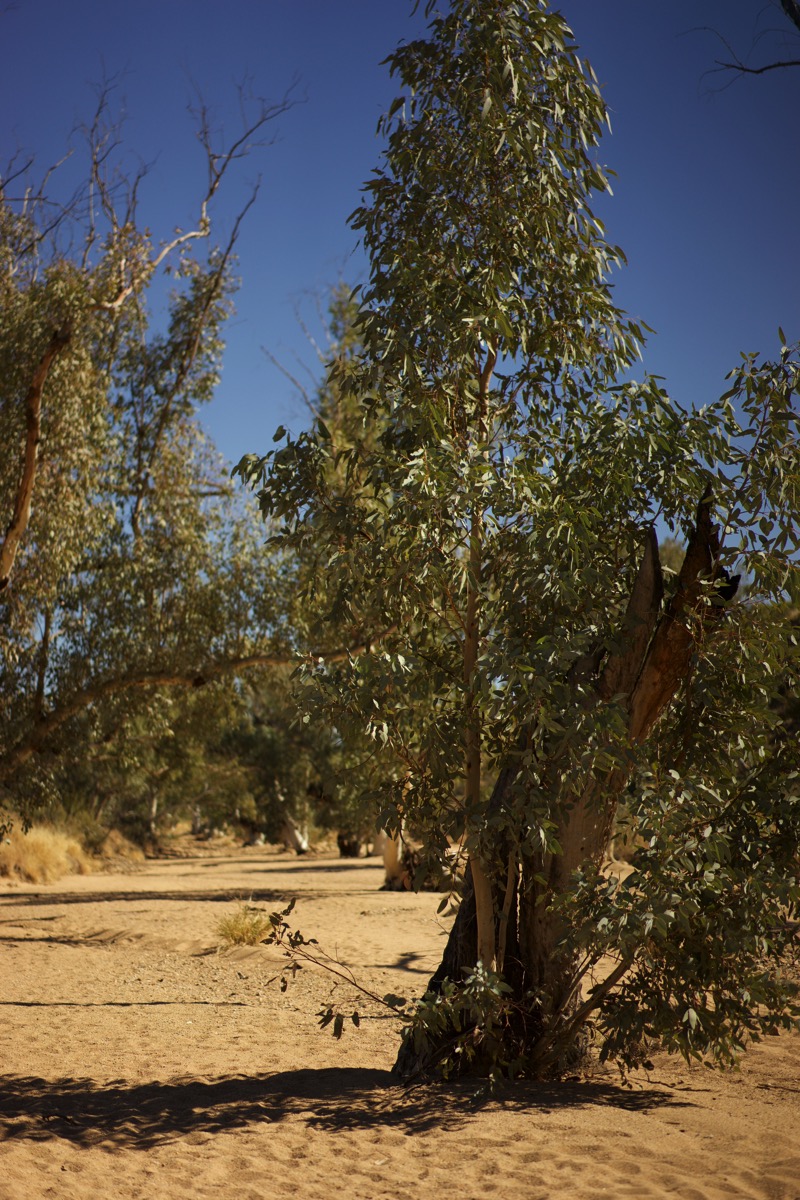
A photograph taken at ground level within what is likely the Sandy River Gorge, featuring several tall, slender gum trees with light-colored bark and sparse green foliage. The ground is sandy or dusty, with dappled sunlight filtering through the leaves, suggesting the presence of a riverine environment conducive to tree growth, despite the "sandy" descriptor. In the background, more trees and vegetation indicate a more vegetated area than depicted in the Heavitree Range photograph, highlighting the unexpected contrast and the wordplay in the post's title.

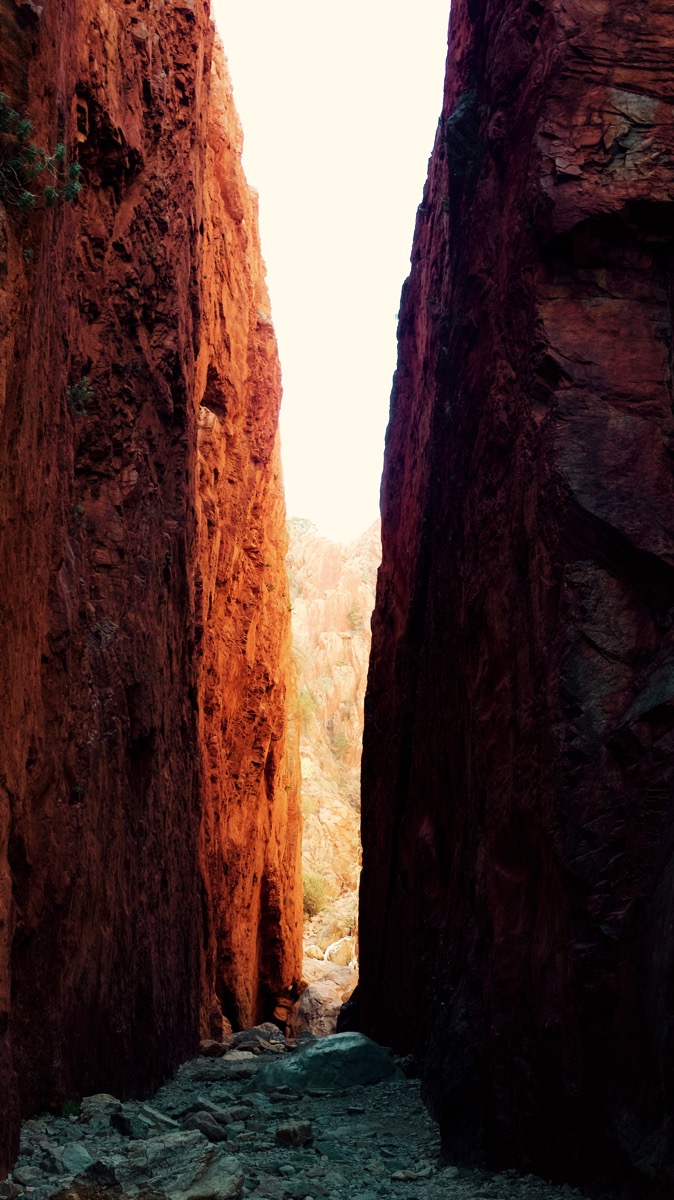
standley’s chasm

A vertical photograph looking up from the floor of Standley Chasm, also known as Angkerle Atwatye, in the Northern Territory of Australia. Two towering, reddish-orange rock walls rise steeply on either side, their vertical textures emphasized by the narrow strip of bright daylight that enters from above. The light powerfully illuminates the sandy ground at the base of the chasm and the top of the rock faces, while the rest of the walls are cast in deep shadow. The image conveys a dramatic sense of scale and enclosure within this significant geological feature of Central Australia.

Ms. Ida Standley 
flinty with resolve
first schooled
the mulatto castoffs in Alice
till the attentions of leery townsmen
dogging her female charges 
drove her bulwark westward
to Ray's Creek 
near the chasm  
the namby magma stretchmark
once extruded through quartzite
worn now down to naught
great Australian orogeny
and misogyny alike
bowing to force of nature
leaving the base cleft

putting on the ritz

on the red centre way
most crossings are regular
kanga cattle schoolkids
wombats

20 klicks from alice
fashion doesn’t just sit
dandy dessert dressage
prances
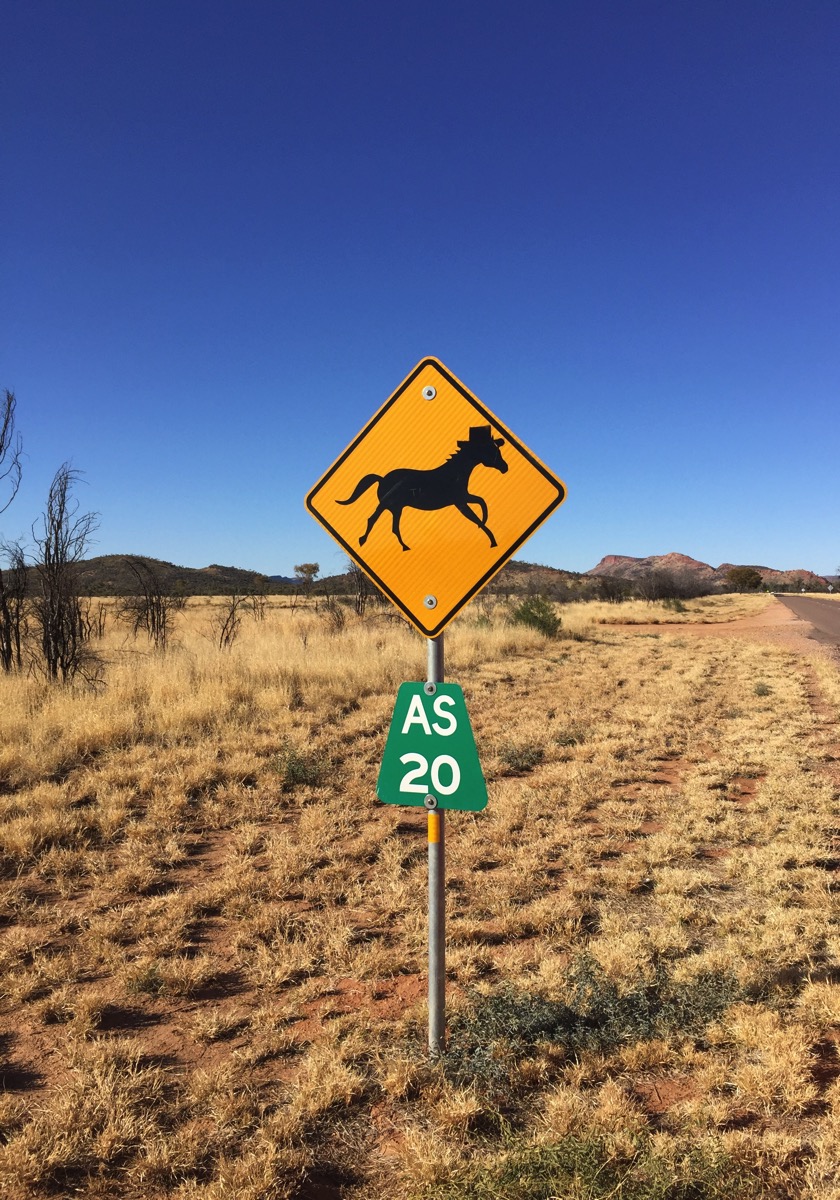
A yellow, diamond-shaped road sign on a dirt road in the Australian Outback. The sign features a black silhouette of a horse in a prancing pose, with a distinct top hat on its head. The image is a direct visual representation of the poem's theme of a "dandy" horse "putting on the ritz" and performing a "desert dressage prance.

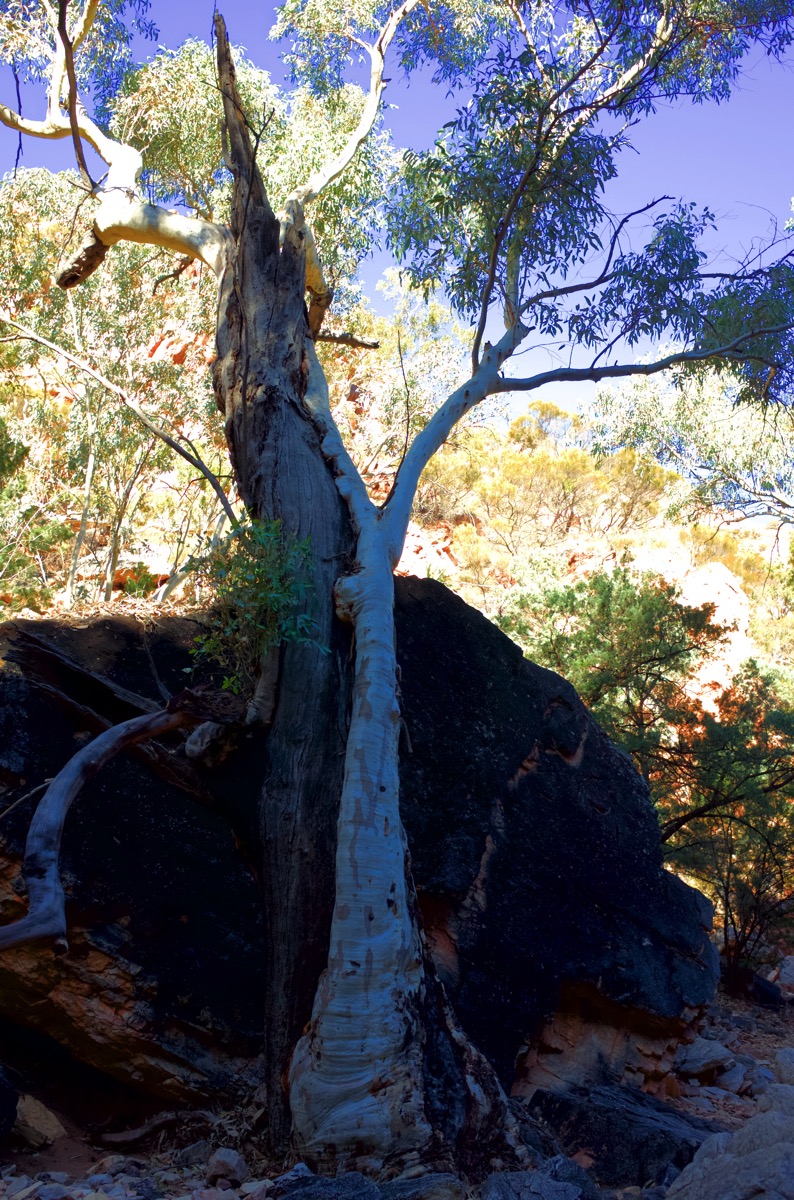
the kiss?

A vertical photograph of two large, pale-barked ghost gum trees whose trunks grow closely together against a dark rock face. The way the trees intertwine, almost "clasping" one another, directly alludes to the post's title, "the kiss?", and to a famous work of art. The unique form of the trees, a significant feature of the Central Australian landscape, is highlighted against the deep shadows and sun-drenched foliage.

at standley chasm
ghost gums clasp
their jutting lust
rock sprung
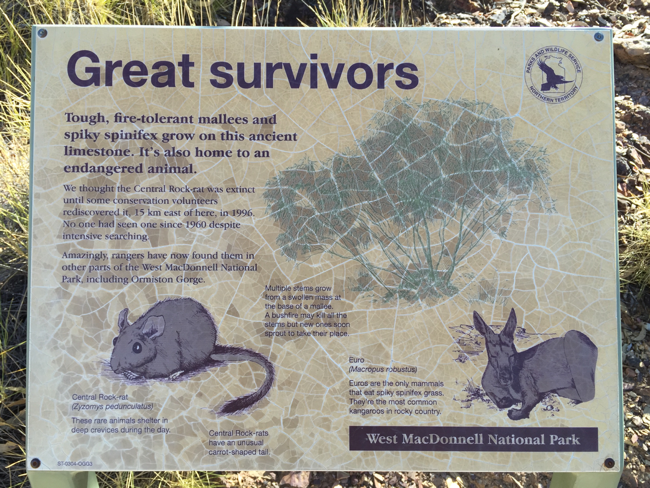
ormiston gorge

A slightly weathered park sign titled "Great survivors" from the West MacDonnell National Park. The sign features text describing the resilient native flora of the region, including "tough, fire-tolerant mallee and spiky spinifex" found on the limestone. It highlights the area as home to an endangered native mouse. Illustrations of two small, grey native mice are prominent on the sign, one on the left and one on the right, set against a stylized background depicting the local environment. The sign also includes a logo of a bird in flight and the words "West MacDonnell National Park" at the bottom.

in the red centre
hardy survivors
stinting spinifex
miserly mallee
thrifty rockrats
and frugal euro


saw the spinifex, mallee and one scampering rockrat
on that ghost gum walk
but no euro
signomi, parakalo
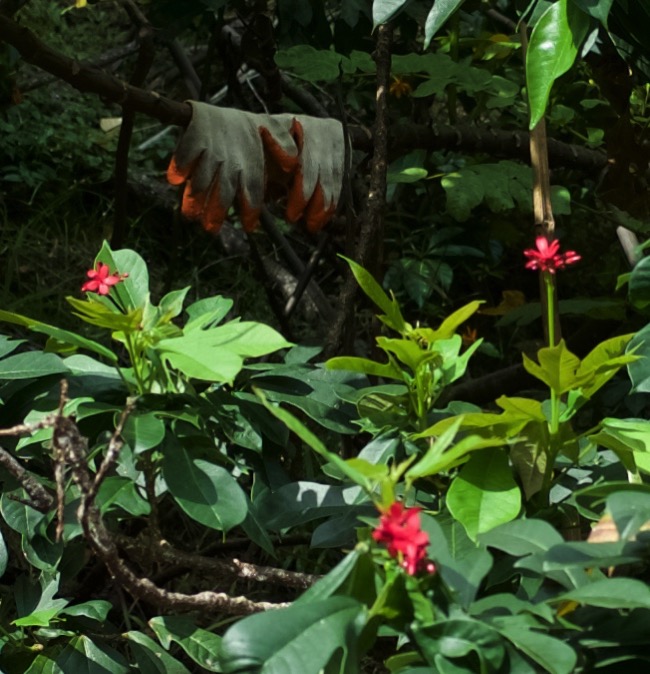
monkey bar

Image

Draft alt-text (revised):
A photograph taken in Singapore, featuring a lush bush with vibrant red flowers and green foliage. Hanging from a branch, likely left behind, is a pair of work gloves. This unexpected sight within the natural setting serves as the inspiration for the post's title, "monkey bar," creating a whimsical juxtaposition.

whose line is it anyway?

Image

A long-exposure photograph taken from a hotel room window in Hungary, showing a cityscape at night. The city lights below are a blurred tapestry of warm tones, over which a series of bright, winding, and abstract lines of light are "drawn." These lines were created by the movement of lights from objects in the sky during the prolonged exposure, serving as the central visual pun for the post's title, "whose line is it anyway?

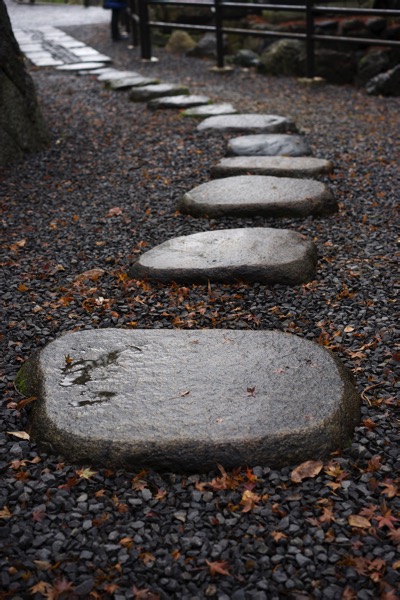
backbone

Image

A path of large, flat, grey stepping stones laid out in a winding, single-file line on a bed of small pebbles and leaves in a Japanese garden. The arrangement of the stones, which recedes into the distance, visually evokes a spinal column, forming the central visual pun for the post's title, "backbone."